Explore movement adapted to your needs.
Choose a service below to learn more.
Tai Chi/Qigong brings breathing, posture and coordinated movement together in an accessible practice.
My sessions draw on this foundation alongside strength, flexibility and mobility exercises, adapted to your abilities and interests. You do not need previous experience or have to learn a complicated sequence.
For residences, CHSLDs, hospitals and clinics
Looking for group classes or a movement program for people receiving care? I adapt mobility sessions to your setting and participants’ abilities.
In Bed or Seated
Gentle movement for those with limited mobility
Who this is for
For anyone with limited mobility or low energy, or who wants a safe place to start: people who are bedridden, use a wheelchair, or spend most of the day seated, including hospital patients (for example, during dialysis) and residents of long-term care or retirement residences.
Our goals
Easing stiffness, breathing and relaxation, circulation, and gentle joint and arm movement, at a pace that respects your body.
What a session looks like
You'll bend and flex your ankles, knees, and hips; look from side to side and up and down; lean gently forward and to each side (as much as is comfortable); turn side to side and back; and move through the full range of motion of your arms and shoulders. Light weights can be added where appropriate.
We can also include Tai Chi/Qigong-based breathing, posture and coordinated movement, adapted to lying down or sitting. We choose movements that fit your comfort, energy and interests, with room for both gentle activity and a sense of calm.
Benefits
- Lubricates joints through gentle range of motion
- Stimulates blood and lymph circulation, supporting organ and immune function
- Builds strength, endurance, and flexibility gently
- Often improves digestion and mood as a side effect of movement
Available individually or as part of a group or institutional program.
"The breathing techniques enabled me to calm myself and catch my breath more easily..."
-
The Residents, Centre d'Hébergement Louis Riel, Montréal
"For a year I have met weekly with John online to address my arthritis and mobility issues. I have noticed a marked improvement in my physical and mental state."
-
Nancy W., Toronto

Seated & Standing
Builds on seated work with careful standing movement to develop balance and strength safely.
Who this is for
This level is for you if you feel unsteady on your feet, tire quickly, or want to get up from a chair more easily. It is a natural next step after seated work, or a starting point if you are already fairly mobile.
Our goals
Leg strength, weight shifting, posture, and balance, always with a chair or support within reach.
What a session looks like
Exercises included in the seated session, plus periods of supported standing movement. Careful arm movements and weight shifting while standing build awareness of safe range of motion, helping you maintain and develop balance while gaining the added benefit of weight-bearing, multi-joint coordination.
Seated Tai Chi/Qigong can be part of this work, coordinating breathing, posture and arm movements. As appropriate, we bring the same principles into supported standing and gentle weight shifts, with a chair or other support nearby.
Benefits
- Develops balance through supported standing
- Builds weight-bearing strength safely
- Improves coordination across multiple joints at once
Available individually or as part of a group or institutional program.
Assessments available
Not sure where to start? Begin with the Tinetti balance and gait assessment, and track your progress over time. (See Assessments below.)
"What sets him apart is his willingness and commitment to providing a program that speaks to my own personal needs which can change from session to session."
-
Sylvia Z., Toronto
"I can remark a considerable improvement in stamina, stability, strength, and flexibility. John is very attuned to temporary weakness and quick to adapt his instruction and monitoring accordingly."
-
Lynn M., Toronto

Standing & Stepping
Balance and stepping work to promote independence in daily activities.
Who this is for
For anyone who walks independently, or mostly, and wants to reduce fall risk and move with more confidence.
Our goals
Skillful weight transfer, controlled stepping, coordination, and whole-body awareness.
What a session looks like
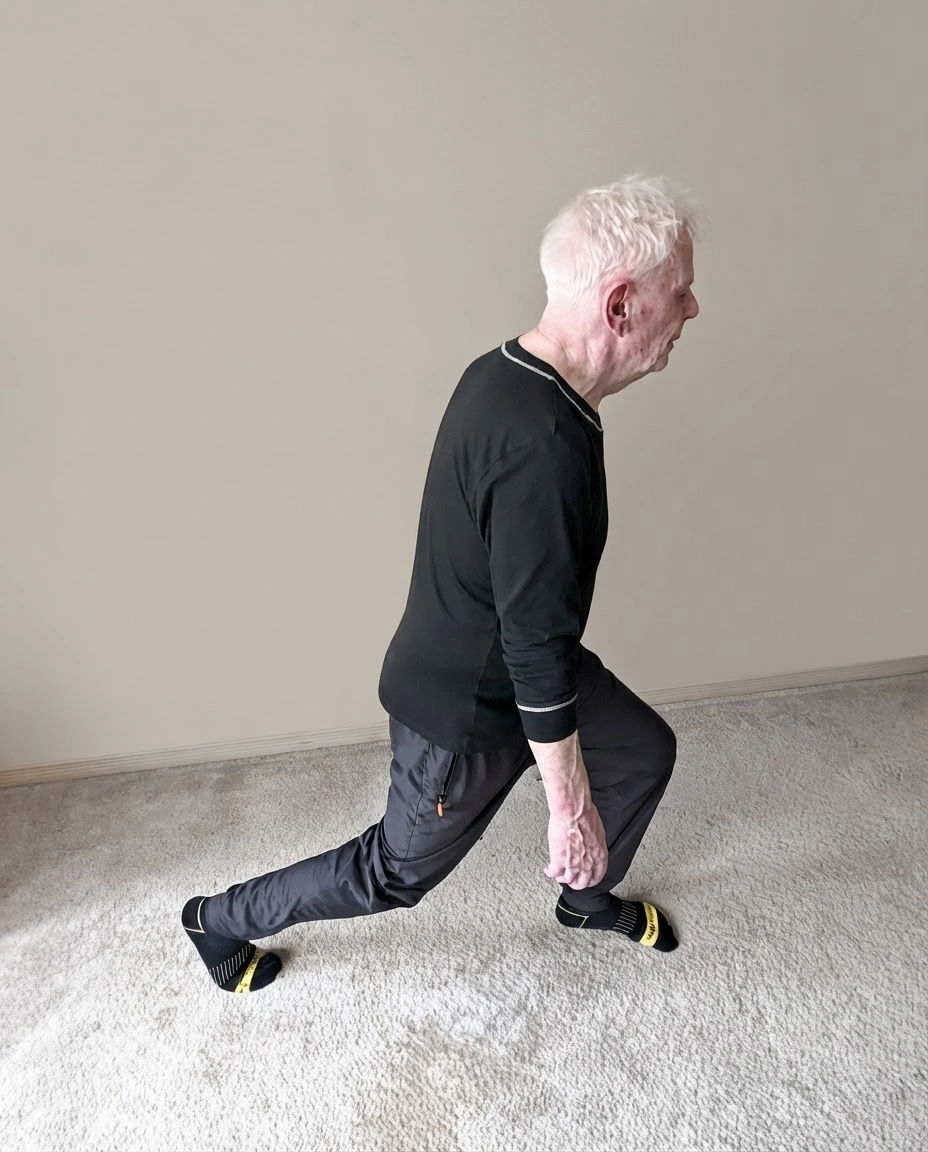
Everything from the seated and standing classes, plus standing and stepping movements — carefully transferring your body weight side to side and front to back. This develops balance awareness during weight transfer, coordinated with upper-body movement, so the benefits carry over into everyday activities.
Tai Chi/Qigong principles connect breathing and posture with controlled weight shifts and coordinated movement. We can explore individual movements, short sequences and stepping practice at a level of complexity that suits your abilities and interests.
Benefits
- Reduces fall risk through practiced weight transfer
- Builds functional strength that transfers to daily movement
- Promotes independence in walking and standing activities
Available individually or as part of a group or institutional program.
Assessments available
Track your progress with the Tinetti balance and gait assessment or the Senior Fitness Test. (See Assessments below.)
"They love his class and feel comfortable in the safe environment with him! He can also easily adapt to individuals when it's required."
-
Cynthia L., Chartwell: Belvédères de Lachine, Montréal
"John is very knowledgeable in his teaching and he is very patient, making sure everyone does enjoy his class..."
-
Benoit P., Santé Active, Montréal
Mobility Assessments
Not sure where to start, or want to measure your progress?
Two assessments are offered as part of the mobility levels above. Each includes a written report.
Tinetti Balance & Gait Assessment
A two-part assessment
-
The first part looks at your balance, the second at how you walk.
-
It helps identify fall risk and shows us where to focus your sessions.
Senior Fitness Test
A set of simple, standardized tests that measure functional fitness - the physical capacity needed to perform normal daily activities.
-
Lower-body strength
-
Upper-body strength
-
Lower-body flexibility
-
Upper-body flexibility
-
Agility and dynamic balance
-
Aerobic endurance
“John's physical education classes were always appreciated by the students. His gentle approach combined with his good mood were highlighted by his students in all his formal evaluations.”
-
Daniel Sincu, Directeur du Collégial, Collège Sainte-Anne
"He showed kindness, punctuality, knowledge of the material, perfectly demonstrated exercises, and patience combined with firmness."
-
Dominique T. , Dorion, QC

Tai Chi for Scoliosis
An individualized approach for teens and adults with scoliosis.
An individualized approach for teens and adults with scoliosis. Every curve is different, so we begin with a detailed assessment and a written report, then build a Tai Chi/Qigong practice around your body. The aim is a longer, more stable back, better symmetry and posture, and a clearer sense of where your body is in space. This work complements other approaches you may be using, including Schroth; it does not replace them.
The approach
- Tai Chi/Qigong movement, breathing and postural work adapted to your scoliosis
- Scoliosis-specific exercises tailored to your curve and presentation, e.g. side plank (if desired)
- Flexibility and myofascial release work if needed
- Breathwork with movements
- Measurement of rotation using a digital scoliometer, so progress is tracked between x-rays (if desired)
For teens and young adults who haven't undergone surgery, the aim is to support the spine's natural alignment through elongation and activation of the convex side; some clients have seen their Cobb angle reduce, and several have seen their rotation ("hump"), as measured with a scoliometer app, decrease. An exercise based approach to support the spine over the life span remains critical in the case of scoliosis.
For older adults (especially those who have had surgery), the priority shifts towards very gently elongating, strengthening and stabilizing the back to support long-term spinal health and improve posture as much as possible.
Tai Chi for Scoliosis is an exercise-based approach and does not replace medical follow-up with your physician or orthopedist.
Scoliosis Assessment
Begin with an understanding of how your body is organized, how it moves, and the features of your curve(s).
Whether we meet in person or over video, the assessment gives us a clear picture of your starting point so your sessions can be built around you.
Posture and spinal alignment
We look at your spine’s curves and rotation, the levelness of your shoulders and pelvis, and your alignment from the front, back, and side. We also check for leg length differences that may be influencing your posture, and create a simple sketch of your spine’s curve(s).
Optional visual tools
For added insight into your curve, you can choose to take dot-sticker photos, which show your curve(s) right on your own back, and to learn how to use a scoliometer app on your phone to record rotation measurements. Both are available in person or online, and although recommended, are entirely up to you.
Movement and balance
We test how fluidly you move, which side you balance on more easily, and how well you follow postural cues.
Mobility, flexibility, and strength
We assess hip range of motion, lower-body flexibility, spinal rotation, and upper-body strength through a progressive series of exercises, so we can start at the right level.
Tracking your progress
If you choose to use the scoliometer, readings are recorded before and after each session so you can see change over time instead of guessing.
"I'm feeling more aligned and more balanced in my dance movements than ever before."
-
Arlene, Montréal
"You really helped reshape both my life and mindset in regard to my scoliosis journey!"
-
Marque R., Montréal
"I highly recommend John for anyone interested in exploring Tai Chi as a complement to traditional physical therapy, or just as a stand alone program to help with balance, coordination, and mobility."
-
Scott Smith, South Carolina, United States
I just wanted to get back to you after our daughters' chiropractor appointment today. He found that she was very much in alignment, he hardly had to do any adjustments."
-
Joan P., Montreal, Canada


Group Classes & Institutional Programs
I work with retirement residences, CHSLDs, hospitals and clinics to bring adapted movement to your residents and patients. Sessions can include in-bed and seated movement, supported standing, or standing and stepping, depending on participants’ abilities.
Classes can include seated or standing Tai Chi/Qigong, combining breathing, posture and coordinated movement with strength and balance exercises. We choose the mix together to suit your participants' abilities, energy and interests.
Who this is for
-
Residences & CHSLDs: Group mobility classes adapted to participants’ comfort, abilities and energy.
-
Hospitals & clinics: Adapted movement for people receiving care, including bedside or seated sessions where appropriate.
-
Planning together: We discuss your setting, participants, session length and scheduling to find a suitable approach.

"In the beginning it was more difficult, but now I have more endurance to do the exercises and improve my health..."
-
Les Résidents
Centre d'Hébergement Louis Riel, Montréal
He's reliable, very knowledgeable and has a genuine rapport with my clients! We are very happy with his services here!
-
Cynthia L.
Chartwell: Belvédères de Lachine, Montréal, Canada